
As a Teacher of Writing:
I believe in the world we live in today, new technologies redefine what it means to be a writer. With new literacies writing as we know it is in constant change ( Leu, Slomp, Zawilinski, and Corrigan) In my classroom that might look like using word processors two create the first draft of a narrative, then using storybird to publish my narrative for the world to enjoy. Students need to know how to be literate with these new technologies, and one important thing to keep in mind is that their audience has transformed from only their peers and me reading it to the entire world.
I believe that students need scaffolds when they are writing, especially when they are first introduced to a new writing style, technique or genre. As teachers of writing, we need to walk them through the process. Using mentor texts as examples, followed by a demonstration of what is expected, until it is their turn to try it out for themselves. Explicit instruction should take a small portion of the writing time. In That Workshop Book, author Samantha Bennett states that we need to give ownership to the students so that the bulk of work time is spent on writing. Eventually, we take the scaffolds off from under the students, and they are writing without our assistance. I want writers to leave my classroom with this ownership.
I believe in always using mentor texts as examples. For example, in Chapter 3 from Write Like This by Kelly Gallagher, she starts out by showing her students the mentor text: Rick Reilly’s (2008) “Weighed Down by too much cash?” Then, Kelly drafts her own version titled “My essay for a rookie teacher” which is modeled after Reilly’s essay. The last image is of a student in Kelly’s class who modeled her essay after both Reilly’s and Kelly’s essays. When I first read this passage, I thought to myself “that’s it?”, but it really is that simple. Introduce a mentor text, MODEL it in front of the students and what you will receive from students is what you set the expectation as.
I believe as a teacher of writing we need to set writing goals for every student. Setting goals help our students grow as writers. In the practicum, we set goals and checked in on these goals each week, if a goal were achieved, we would make a new goal. This kept my feedback to my tutee clear and consistent. Jennifer Serravallo suggests that teachers come up with a goal for each student. In her writing camp on informational writing, she would set a clear goal for us as the students and work towards that one goal.
I believe that our students require feedback. The feedback that is focused, empowering, and asks questions is most effective. (Ebarvia) In our practicum, we provided our tutees with something they did well and one or two things they could work on. This made the process of revising and editing be a success each week. Our students need to know why their writing is “good,” and they need to why they are fixing it as well.
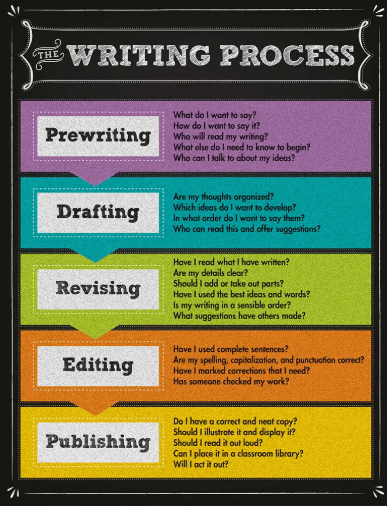
I believe that writing is a process.
1.Prewriting 2.Drafting 3.Revising 4.Editing 5.Publishing
This writing process is aligned with the metacognitive theory, a constructivist view that metacognition is the process of thinking about one’s own thinking. (Tracey, Morrow 2017) In this lens, the writer is aware of the choices they make in their own writing, is then able to follow the instructional process of writing, and continue to use this to create more and more pieces of writing. As a teacher of writing, I must introduce this process to my students and make it clear that writing is a continuum.
 I believe students suffer from page fright. Anderson says it best in 10 Things Every Writer Needs to Know, “we must simply begin.” We need to motivate our students for any writing to begin. The basic source of students lack of motivation is the writing tasks themselves. (Graham, S., MacArthur, C., & Fitzgerald, J.) In the classroom, this can be fixed and might look like giving our students choice in what they want to write about, making topics interesting, and even trying something new daily or weekly with a fresh new writing prompt to just activate the motivation to write. Children’s author and writing teacher Amy Ludwig VanDerwater keeps a notebook resource here if you ever run out of inspiration and based on the extensive blogs she runs, she believes in maintaining a writing notebook in the classroom.
I believe when my students leave the classroom they have become better writers. The NCTE states that for this to occur I must provide high-quality writing opportunities, use new literacies and forms of writing, my students need to know that writing is a process and that writing should be used as a tool for thinking.
I believe that with literacy there is so much to learn, and as I learned from this class you can teach writing for years and still learn each day. I have been introduced to teaching literacy. This is just the beginning, and I am excited. I have had opportunities to practice writing and shake off the rust on informative, narrative and poetry. I walk away from this class confident that I can begin to teach these genres more effectively. I received practice on giving feedback through the writer’s workshop. The virtual setting provided me with opportunities to practice, fix and practice some more. I will seek out more opportunities to offer and work on giving feedback. I am excited. I am a teacher. I am a writer.
References
Anderson, J. (2011). 10 Things Every Writer Needs to Know (1st ed.). Stenhouse Publisher.
Bennett. S (2007) That workshop book ( Chapter one- Why Workshop?).
Ebarvia, T. (2017).Moving writers: In the pursuit of meaningful feedback
Gallagher, K (2011) Chapter 3 from Write Like This
George, S, Serravallo, S (2018) Summer Writing Camp Week Three Wrap-Up Heinemann Blog
Graham, S., MacArthur, C., & Fitzgerald, J. (2013). Best practices in writing instruction (2nd ed.). New York: Guilford.
Leu, D., Slomp, D., Zawilinski, L., & Corrigan, J. (2016) Writing Research Through a New literacies Lens. Writing Research- New Literacies
NCTE (2016) Professional Knowledge for the Teaching of Writing
http://www2.ncte.org/statement/teaching-writing/
Tracey, D.H. & Morrow, L.M. (2017). Lenses on Reading: An introduction to theories and models. Guilford Press: New York.
VanDerwater, A.L (2018) Sharing Our Notebooks Blog http://www.sharingournotebooks.amylv.com/
 A Teacher. A Writer.